Book Trucks Online Across India with TruckGuru
Know your truck transport cost before booking. Full truckload rates from Rs.26 per km, confirmed upfront, with GPS tracking and digital documents on every trip.
- ✓Verified Trucks
- ✓Live Tracking
- ✓Transparent Pricing
- ✓Digital POD
Book Your Truck in Minutes
Get instant rates with transparent pricing confirmed before dispatch — no hidden charges. Only pay at booking confirmation, advance after loading, and the balance upon unloading.
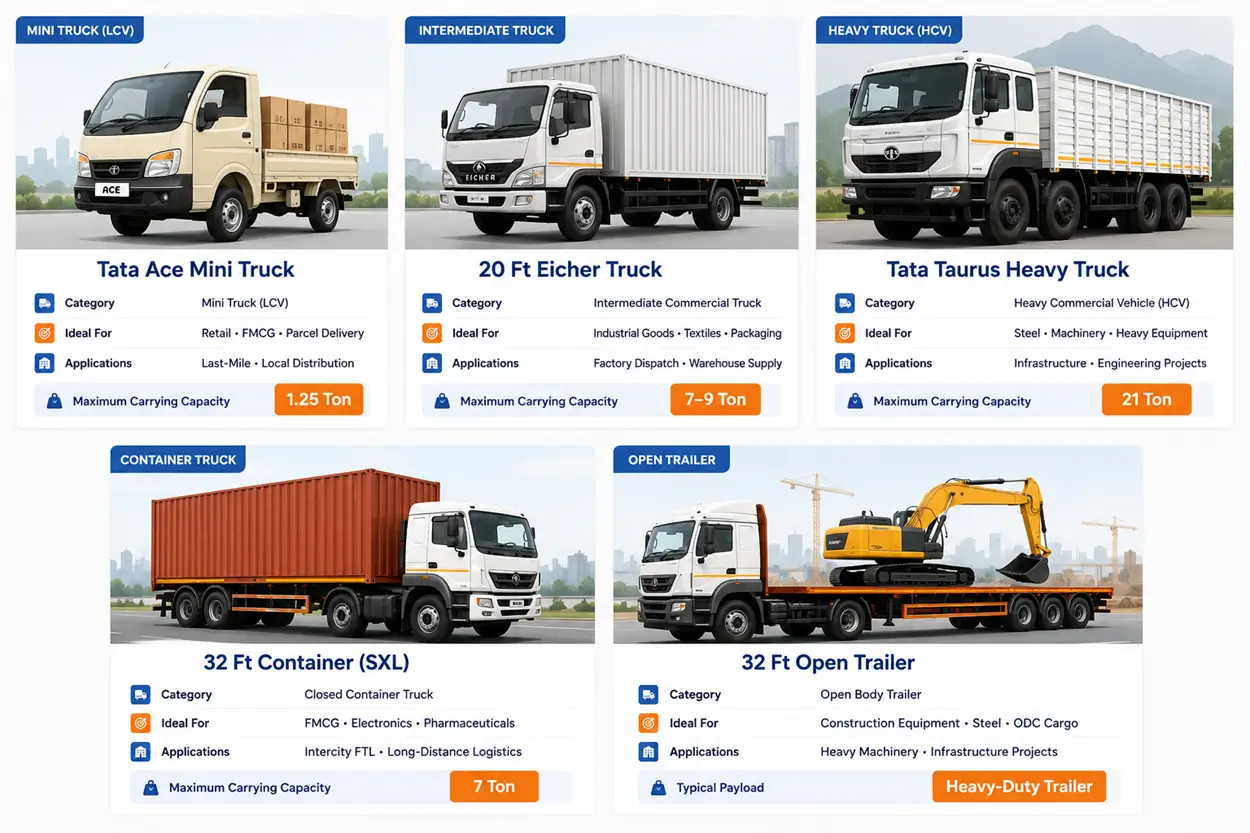
Truck Types in India (2026) – Pick the Right Vehicle for Your Cargo
Every truck on Indian roads falls into one of a few categories -- but those categories matter more than most shippers realise. A 32 ft container and a 32 ft open-body trailer are the same length, but booking the wrong one for pharmaceutical cartons versus steel rods is a costly error that shows up as damaged goods, rejected deliveries, or insurance claims that go nowhere.
This page breaks down truck types by what they are actually built to carry, how they load, and which industries use them. If you need exact measurements and dimensions in feet, head to the Truck Size Guide -- that page has the full chart. This one is about matching the right vehicle category to your freight.
How Trucks Are Classified in India
Indian commercial vehicles are grouped by Gross Vehicle Weight (GVW) into three regulated categories. This is not just an industry label -- it affects which driving licence the driver needs, what toll rates apply, and where the vehicle can legally operate.
Light Commercial Vehicles (LCVs) -- GVW up to 7.5 tonnes. These include mini trucks like the Tata Ace/Intra and Bada Dost, as well as mid-range vehicles like the 14 ft Eicher. LCVs do not need a heavy vehicle licence, which means a wider pool of drivers and faster truck availability on most corridors. Toll charges are also lower, which brings down the total trip cost on routes with multiple toll plazas -- something shippers on the Mumbai-Pune or Delhi-Jaipur corridor notice on every invoice.
Medium Commercial Vehicles (MCVs) -- GVW 7.5 to 16 tonnes. The 19 ft and 20 ft trucks sit here. These vehicles handle the bulk of intercity B2B freight -- factory dispatches, distributor replenishments, and multi-SKU loads that need more floor space than a 14 ft body can offer. MCVs require a heavy vehicle driving licence, which slightly narrows driver availability compared to LCVs.
Heavy Commercial Vehicles (HCVs) -- GVW above 16 tonnes. This is 32 ft container territory. SXL, MXL, and multi-axle trailers fall here. Route permits, higher toll rates, and restricted entry timings in metro cities all apply. If your load pushes past 10 tonnes or your consignment fills a full 32-foot body, this is where you end up.
For exact dimensions of each vehicle in this classification, see the Truck Size Chart.
Closed Body Trucks (Container Trucks)
Closed containers are the default for any cargo that cannot get wet, dusty, or tampered with in transit. The body is fully enclosed -- welded steel walls, a lockable rear door, and a roof that keeps out monsoon rain on a 36-hour Mumbai to Kolkata run.
What moves in closed containers: FMCG cartons, electronics, pharmaceuticals, textiles, packaged food, auto parts, and retail inventory. If your goods are packed in corrugated boxes or shrink-wrapped pallets, a closed container is almost always the right call.
Where they work best: Intercity FTL routes of 300 km and above. On shorter runs within a single state, the cost difference between open and closed is smaller, but the cargo protection still matters for high-value goods.
Axle configurations you will see:
The 32 ft container comes in two main variants -- Single Axle (SXL) and Multi-Axle (MXL). The SXL carries 7-8 tonnes and is the standard for voluminous but lighter cargo like FMCG cartons and packed electronics. The MXL handles 15-18 tonnes and is built for denser loads -- industrial machinery parts, raw materials, and heavy manufacturing dispatches.
One thing that catches first-time shippers: an SXL and MXL look almost identical from the outside. Same 32-foot body length. The difference is underneath -- the MXL has additional axles and a heavier chassis, which is why it costs more per kilometre but carries roughly double the weight.
20 ft containers are a good middle ground when your load does not fill a 32-footer. At 6.5 tonnes capacity, they work well for regional dispatches where you are moving enough to justify a dedicated truck but not enough to warrant a full 32 ft booking. Check what a 20 ft container costs on your route.
Open Body Trucks and Flatbeds
Not everything fits inside a box. Steel pipes, construction rebar, heavy machinery, pre-fabricated structural components, and over-dimensional cargo (ODC) need open-body trucks that allow crane loading from the top or side.
What moves on open bodies: Steel coils, TMT bars, cement bags (when tarped), timber, granite slabs, agricultural equipment, and any machinery that exceeds the internal height of a closed container. If your cargo needs a forklift or crane to load, you are almost certainly looking at an open body.
The trade-off is straightforward. Open trucks cost less per trip than equivalent closed containers, but your cargo is exposed to weather. For monsoon-season dispatches, this means proper tarpaulin coverage and waterproof wrapping at the loading point -- the truck provides the tarp, but securing moisture-sensitive goods is the shipper's responsibility.
ODC (Over-Dimensional Cargo): Loads that exceed standard width or height limits -- think industrial boilers, transformer units, or construction cranes -- require ODC permits and route surveys before dispatch. These are booked on a case-by-case basis with lead time for permit clearance. If your cargo qualifies as ODC, call TruckGuru at +91-7202045678 before placing a standard booking.
Mini Trucks and Pickups -- The Sub-2-Tonne Category
For consignments under 2 tonnes that need to move between cities, mini trucks and pickups are the most cost-effective option. You are not paying for 32 feet of container space when your cargo fits on 7-9 feet of bed length.
Tata Ace (Chota Hathi): The most common mini truck on Indian roads. Around 750 kg to 1100 kg capacity. Fits easily through narrow lanes and industrial estate internal roads where larger vehicles cannot enter. If you are dispatching retail inventory to a shop in a congested market area, the Ace/Intra is usually the first vehicle that comes to mind. You can book a Tata Ace here.
Bada Dost (1.5 tonne): When your load is too heavy for an Ace but does not justify a 14 ft Eicher, the Bada Dost fills the gap. Widely used for e-commerce fulfilment centre dispatches, small-batch manufacturing shipments, and agricultural produce movement between mandis and cold storage facilities.
Mahindra Bolero Pickup: Common across semi-urban and rural India for agricultural produce and building materials. Fleet availability through TruckGuru varies by corridor -- check your route before planning around this specific model.
Eicher and Mid-Range Trucks -- The B2B Workhorse
If you run a manufacturing unit or distribution business, chances are most of your freight moves in an Eicher. The 14 ft, 17 ft, and 19 ft variants cover the widest range of intercity B2B cargo in India.
14 ft Eicher (3.5 tonnes): The default first choice for mid-volume intercity freight. Fuel-efficient enough that the per-km rate stays competitive even on 800-1,000 km corridors. Most textile manufacturers in Surat, auto parts distributors in Pune, and electronics wholesalers in Delhi use this truck more than any other. Check Eicher rates on your corridor.
17 ft Eicher (5 tonnes): A step up when your cargo volume crosses what a 14-footer can handle but weight stays under 5 tonnes. Common for FMCG dispatches where carton count matters more than weight -- 150 cartons of packaged snacks weigh less than they look, but they need floor space.
19 ft / 20 ft trucks (6.5-7 tonnes): For factory-to-warehouse movements, bulk dispatches, and multi-pallet loads. When a distributor in Bangalore orders 6 tonnes of auto components from a Pune manufacturer, this is typically the truck that gets booked. The 20 ft container version adds weather protection for the same weight class.
How to Pick the Right Truck Type -- A Practical Decision Framework
Forget the spec sheets for a moment. Here is how experienced logistics managers actually decide:
Start with the cargo, not the truck. What are you shipping? Cartons of finished goods that cannot get wet go into a closed container. Steel rods that need crane loading go on an open body. This single question eliminates half the options immediately.
Then check the weight. Under 1.5 tonnes -- mini truck or pickup. Between 1.5 and 5 tonnes -- Eicher 14 ft or 17 ft. Between 5 and 8 tonnes -- 19 ft or 20 ft truck. Above 8 tonnes -- 32 ft SXL or MXL container.
Then check the volume. Weight is not the only constraint. Thermocol packaging, mattresses, and furniture weigh very little but take up a lot of space. A 2-tonne shipment of cushion-packed electronics might need a 14 ft truck even though the weight would fit on an Ace. When in doubt, share your cargo dimensions and TruckGuru will recommend the right vehicle.
Finally, check the route. Some corridors have restricted vehicle entry timings for HCVs. Mumbai, for example, restricts heavy vehicles during daytime hours within city limits. If your delivery window is tight, an LCV that can enter the city at any hour might be a better choice than an HCV that has to wait until 11 PM for entry clearance.
Use the freight calculator to compare costs across vehicle types for your specific route.
Industry-Specific Truck Selection
Different industries have settled on specific truck types over years of operational experience. Knowing what works in your sector saves trial-and-error:
FMCG and packaged goods: 14 ft Eicher for distributor replenishments, 32 ft SXL for depot-to-depot transfers. Always closed body -- carton integrity matters for retail shelf presentation.
Auto parts and components: 14 ft to 20 ft Eicher depending on order size. Mixed loads (multiple SKUs, multiple part numbers) are common. Closed containers prevent part damage and simplify unloading at the warehouse.
Textiles and garments: 14 ft Eicher is the standard for Surat-to-Mumbai or Tirupur-to-Chennai corridor traffic. Closed body is non-negotiable -- one rain-soaked consignment can wipe out the margin on an entire order.
Construction and infrastructure: Open body trucks and flatbed trailers. Steel, cement, rebar, and pre-cast components need top or side loading. Weight is the primary constraint, not volume.
Pharmaceuticals: Temperature and contamination sensitivity means closed containers only. Most pharma dispatches from Hyderabad and Ahmedabad manufacturing clusters move in 14 ft or 20 ft closed-body trucks with additional cargo securing inside.
FAQs -- Truck Types in India
What is the difference between a container truck and an open body truck? A container truck has a fully enclosed metal body -- walls, roof, and a lockable door. Cargo stays protected from rain, dust, and tampering. An open body truck has no enclosure, which allows crane or forklift loading from the top and sides. Choose container for packaged goods, open body for steel, machinery, and construction materials.
Which truck type is best for FMCG goods? Closed container trucks -- either a 14 ft Eicher for smaller distributor deliveries or a 32 ft SXL for full-truck depot transfers. Carton integrity is critical for retail presentation, and a closed body prevents damage from weather and road dust.
Can I book an open body truck for long-distance routes? Yes. Open body trucks run intercity routes regularly, especially for construction materials and industrial cargo. The cargo needs tarpaulin coverage for weather protection, which the truck provides. For loads above standard width or height, you may need an ODC permit -- check with TruckGuru before booking.
What does SXL and MXL mean? SXL stands for Single Extra Long -- a 32 ft container with a single rear axle, carrying 7-8 tonnes. MXL stands for Multi Extra Long -- same 32 ft body but with multiple axles and a heavier chassis, carrying 15-18 tonnes. The MXL costs more per kilometre but is the only option for loads above 10 tonnes.
How do I know if my cargo qualifies as ODC? Over-Dimensional Cargo exceeds standard truck dimensions in width (above 2.6 metres) or height (above 3.8 metres from ground). Industrial machinery, transformer units, and large fabricated structures typically fall in this category. ODC loads require special permits and route surveys.
Is a mini truck enough for intercity transport? For loads under 1.5 tonnes moving between cities within 300-500 km, yes. The Tata Ace and Bada Dost handle intercity runs regularly. Beyond 500 km, factor in the longer transit time compared to a larger truck that covers ground faster on the highway.
Which truck types does TruckGuru offer? TruckGuru's fleet covers Tata Ace, Bada Dost, 14 ft / 17 ft / 19 ft Eicher trucks, 20 ft containers, and 32 ft SXL and MXL containers. Open body trucks and ODC trailers are available on select corridors. Enter your route on the booking page to see available vehicle types.
What is the cheapest truck type for intercity freight? For light loads (under 1100 kg), the Tata Ace is the most economical. For 2-4 tonne loads, the 14 ft Eicher offers the best balance of capacity and per-km cost. Oversizing your truck wastes money just as much as undersizing it -- match the vehicle to the load, not the other way around.
A Rapidly Growing Truck Booking Network India
Trusted by 5000+ Businesses Across India
Serving leading enterprises, government organizations, manufacturers, retailers, and industrial businesses with reliable truck transportation services across India.














Pick the Right Truck for Your Load
Per-km rates shown upfront. Not sure which size fits? Share the weight and our team will recommend one.
Ashok Leyland Bada Dost
Up to 1.5 ton · FMCG, retail cartons, light industrial goods
20 FT Container
6.5 ton · Closed-body bulk freight, weather-sensitive cargo
32 FT Container
7 to 18 ton variants · Full corridor loads, plant-to-warehouse
Online Truck Booking Across Major Cities India
 Mumbai
 Pune
Pune Bangalore
 Chennai
 Ahmedabad
 Kolkata
 Hyderabad
 Delhi NCR
Our Strengths and Advantages
We care deeply about the work we do. Our focus has always been on helping businesses move their goods safely, smoothly, and without unnecessary stress. When you choose us, you get a reliable transport partner that supports your daily operations while you focus on running your business.
Full Load Services
We offer full truck load transport with different types of trucks, making it easy to choose with the click of a button.
Transparent Pricing
Our pricing is clear and upfront. You can check the transport cost online before booking.
Quick & Easy Portal
Booking a truck is simple and hassle-free. Our online portal is designed to save your time and reduce paperwork.
Advance Booking
You can plan ahead with advance bookings and be assured that vehicles will be available when you need them.
Built for Businesses That Ship Every Week
Everything a dispatch team needs on one platform: confirmed pricing, verified trucks, and paperwork that generates itself.
Live GPS Tracking
Every truck on the platform carries GPS. Watch your consignment move on the map and share the link with your consignee.
Transparent Per-km Pricing
Rates from Rs.26 to Rs.91 per km depending on truck size. The fare you confirm at booking is the fare you pay.
Verified Transporter Network
Bookings are fulfilled by a verified network of 10,000+ trucks covering 500+ locations across India.
Digital LR, Invoice and POD
Lorry receipt, GST invoice, and proof of delivery are generated digitally on every shipment. No paper chase.
Same-day Truck Confirmation
Trucks are confirmed within the same day in most cases, and you can lock a dispatch date in advance for peak seasons.
Support That Picks Up
Book through the website, the app, or the call center. A support team is available round the clock while goods are in transit.
How it Works?
1. Book Your Truck Through Website, App & Call center.
2. Our Agent Finds Nearest Truck For You
3. Get updates & notifications via SMS, WhatsApp & Email
See Every Truck. Skip Every Follow-up Call.
Once your shipment moves, its position updates live on the map. Share the tracking link with your buyer or warehouse so unloading is planned before the truck arrives.
We Are Loved By Users And Clients
"TruckGuru's commitment to seamless load handling and rapid response time truly stood out to me. Their dedication to ensuring on-time deliveries was evident throughout the process. I wholeheartedly endorse and highly recommend their services."

"TruckGuru impresses us with its promptness, responsiveness, and excellent organization. They are safe and keep our logistics on time, to a Pan India location with so much ease! The team truly pulled it together".

Hire a Truck Without the Hassle
Frequently Asked Questions
Moving Goods Is Simple with
TruckGuru
Tips for Booking a Truck
Start with the weight and dimensions of your goods, not the truck size. A 2-ton textile shipment from Surat to Mumbai fits comfortably in an Eicher 14FT (3.5T capacity, Rs.31-35/km). Picking the wrong truck size is the most common reason shippers overpay on freight.
Get your rate confirmed before the truck is dispatched. On TruckGuru, the price you see at booking is the price you pay. The split is simple: 5% at booking, 90% at loading, 5% before unloading. If a platform or broker revises the rate at the loading dock, that is a red flag.
Check whether the transporter provides live GPS tracking and digital documentation including LR, invoice, and POD. Chasing a driver by phone for location updates wastes hours every trip. On busy corridors like Ahmedabad-Mumbai or Delhi-Jaipur, a single delayed update can throw off your warehouse unloading schedule.
Book 2-3 days ahead when possible. Same-day availability is common on most routes, but during October-December peak season, trucks on high-demand corridors fill up fast. Advance booking also gives you better vehicle options for goods that need closed-body or containerised transport.